Testing
Why Advanced Health Testing Is the First Step to Better Health
Most plans start with a guess. Here is what DEXA, RMR, VO2 max and labs show, and why measuring first changes every decision.
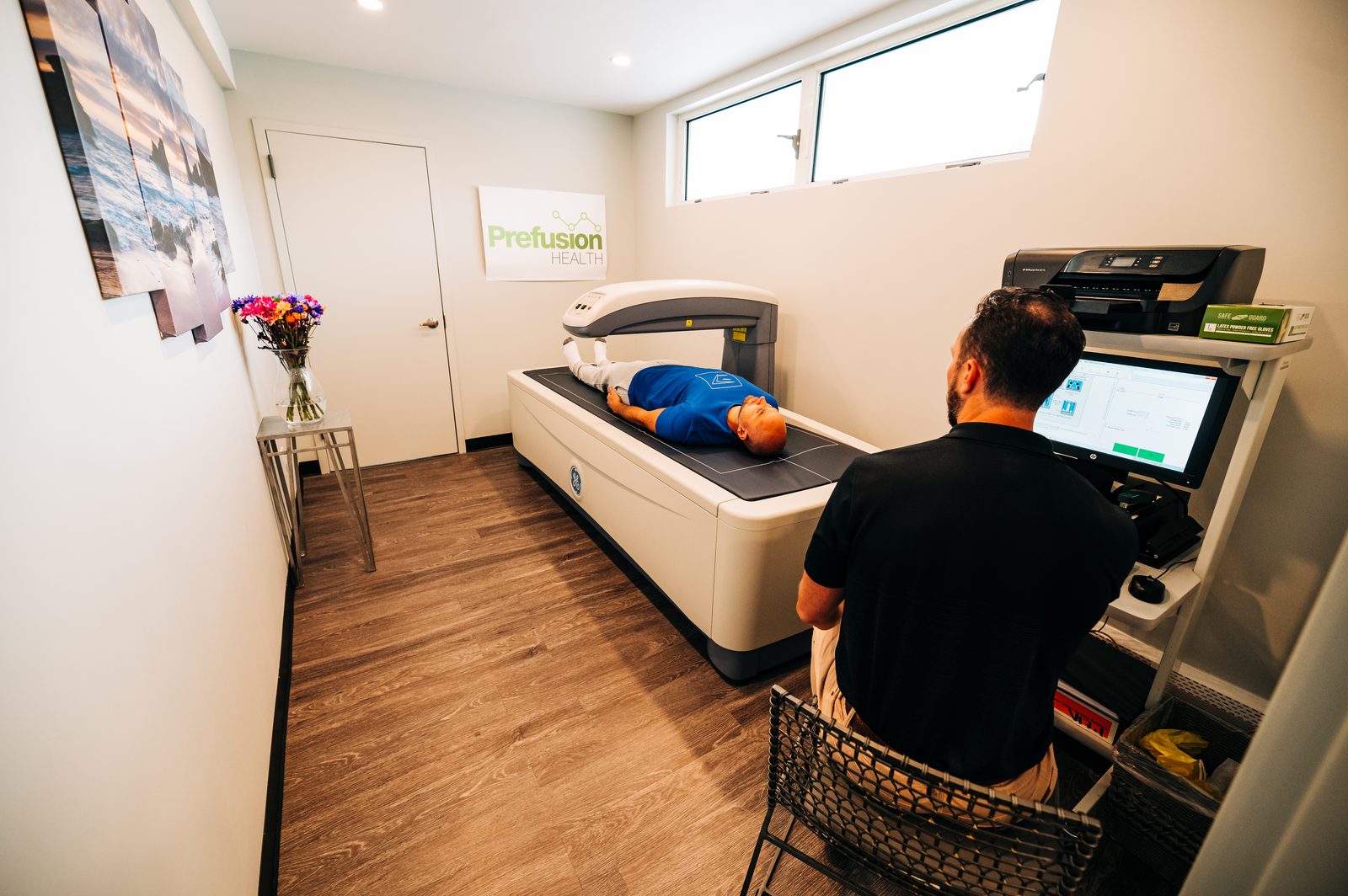
Two people can weigh exactly the same and have completely different bodies. That is the gap a DEXA scan fills. It is often called the gold standard for body composition, and it takes about seven minutes. Here is what a DEXA scan is, how it works, what it measures and what to expect at Prefusion Health in New York.
DEXA stands for Dual-Energy X-ray Absorptiometry. It is a medical-grade scan that measures body fat percentage, lean muscle mass, visceral fat and bone mineral density in one non-invasive session of about seven minutes.
It gives you a true picture of your body: not an estimate from a scale or a watch, but a measurement. Prefusion Health uses a medical-grade GE DEXA scanner, and your results are explained by your care team before you leave.
The idea is simple. Fat, lean muscle and bone absorb X-rays differently. A DEXA scanner passes low-dose X-rays at two energy levels through your body, and by comparing how much is absorbed, it separates your body into its components. That is the "dual-energy" part of the name.
The result is a detailed breakdown of what your weight is actually made of, and where it sits. The radiation dose is very low, which is why the scan is suitable for regular retesting.
A standard DEXA scan at Prefusion Health gives you:
Visceral fat sits around your internal organs rather than under your skin, and it is the fat most closely linked to long-term metabolic risk. A DEXA scan is one of the few accessible tests that can measure it. A scale, a wrist device or calipers cannot.
Because the scan reports lean mass by region, it shows left-right and regional muscle imbalances. Your training plan can then address them directly instead of guessing.
The same scan reads bone density, an early health marker that most routine checkups skip.
A scale measures one thing: total weight. It cannot separate fat from muscle, and it cannot see visceral fat. Body fat scales estimate fat using a small electrical signal, which shifts with how hydrated you are. DEXA measures fat, muscle and bone directly.
That difference matters most when you are working toward a goal. If you are losing weight, you want to know whether it is fat or muscle. If you are training hard, you want to know whether you are actually building muscle. The scale cannot tell you. DEXA can.
If you are actively working toward a fitness or weight-loss goal, scanning about every 90 days gives your body enough time for a meaningful, measurable change between scans. One Prefusion member, Nicole, scanned in January and came back in May: she had lost 4.5% body fat, and the scan showed exactly where it came from.
If you plan to retest, the Metabolic Reset (two DEXA scans and an RMR test) and the Flex Pack (four tests in any mix of DEXA and RMR) are built for it.
A DEXA scan shows what your body is made of. It does not show why. If you want the full picture, the Prefusion Protocol combines DEXA with an RMR test and comprehensive labs, reviewed by our medical team. If you want your full physical baseline in one visit, the Optimization Pack adds RMR and VO2 max.
$179 per scan, about seven minutes, in Manhattan, Bellmore or Stony Brook.
Measuring body composition: body fat percentage, lean muscle mass, visceral fat and bone mineral density. It is used to track fat loss, muscle gain and bone health with far more precision than a scale.
About seven minutes on the scanner, fully clothed, with no needles or discomfort.
Yes. It is one of the few accessible tests that can measure the fat stored around your internal organs.
About every 90 days if you are working toward a fitness or weight-loss goal.
Prefusion Health offers DEXA scans in Bellmore and Stony Brook on Long Island, and in Manhattan.
This article is for general education and is not medical advice. Whether a test or therapy is right for you is decided with your provider, based on your health history and results.
Most plans start with a guess. Here is what DEXA, RMR, VO2 max and labs show, and why measuring first changes every decision.
How GLP-1 therapy works, what the common side effects are, and why the scale is the wrong way to judge it.
Book your baseline and let the data do the talking.