
DEXA scan
DEXA Scan Cost in NYC and Long Island: What Is Included?
What a $179 DEXA scan includes, how to prepare, and where to book in Manhattan, Bellmore and Stony Brook.
You have been training consistently, paying attention to what you eat and feeling stronger. Your clothes fit differently. But when you step on the scale, the number has barely moved. Does that mean you are not making progress? Not necessarily.
Your body can change even when your weight stays the same. You may be losing fat while gaining or keeping muscle. That is body recomposition: improving the balance between fat and lean tissue, rather than simply lowering your total weight. This guide covers how it works, what drives it, and how to track it properly.
Body recomposition means changing the proportion of fat and lean tissue in your body, usually by reducing fat while building or preserving muscle. Your weight is made up of fat, muscle, bone, organs and water. Most weight-loss plans only watch the total. Recomposition looks at which tissues are actually changing.
Weight loss means your total weight went down. It does not tell you whether that weight came from fat, muscle, water or all three.
| Traditional weight loss | Body recomposition |
|---|---|
| Focuses on lowering total body weight | Focuses on the balance of fat and lean tissue |
| Measured mainly on a scale | Tracked with several body composition measures |
| Can mean losing fat and muscle | Aims to lose fat while gaining or keeping muscle |
| Weight usually goes down | Weight can go down, up or stay the same |
Neither goal is automatically better. The right one depends on your health, your starting point and what you want.
Yes, but it is not guaranteed. People who are new to strength training, coming back after a break, or starting with higher body fat usually see the clearest changes. People who are already lean and well trained find it harder to do both at once.
Two things happen side by side: your body uses stored fat, and your muscles get a reason to grow or hold on.
Fat loss happens when your body uses more energy than it gets from food over time. A very large calorie deficit makes it harder to train well and hold on to muscle, especially if protein and recovery are low. For recomposition, a moderate approach usually works better than aggressive dieting. Knowing your real resting calorie burn from an RMR test helps you set that target.
Squats, rows, presses and other resistance work challenge your muscles, and they adapt by getting stronger and bigger. Over time you add weight, reps or volume. That is progressive overload. Good technique and steady progress matter more than lifting heavier every session.
Protein supplies the building blocks your muscles need to adapt. Sleep and rest days matter too: training is the stimulus, but much of the change happens between workouts.
You do not need complicated food rules. The goal is to fuel training and recovery while managing your total intake.
The hardest part of recomposition is knowing whether it is working. The scale alone cannot tell you, so use a few measures together.
Weight moves through the day with food and hydration. If you track it, look at the trend over weeks under the same conditions. And remember that a stable weight does not mean nothing has changed.
Waist, hip, arm and thigh measurements can show changes the scale misses. Use the same tape, the same spot and the same method each time. They are cheap and practical, but they cannot tell fat from muscle.
Lifting more weight, doing more reps or moving with better control are real signs of progress. Strength also improves with technique, though, so read it alongside your other measures.
A DEXA scan uses two low-dose X-ray energies to measure what your body is made of, in about seven minutes. It reports:
DEXA lean mass includes muscle plus water and other soft tissue, so it is not a pure muscle number, and very small changes between scans can be normal variation. Even so, it shows what no scale can: whether you lost fat, gained lean mass, or both.
Say your first scan shows 30% body fat and a later one shows 27%. That suggests fat now makes up less of your weight. Read it next to your actual fat mass and lean mass, because the percentage can also drop when lean mass goes up.
DEXA shows lean mass in your arms, legs and trunk, so you can see whether your training is changing the areas you are working on, and spot left-right imbalances. Scan under similar conditions each time so hydration and positioning do not blur the picture.
Your first scan is your starting point. Scanning again about every 90 days gives your body time to make a change you can measure. If you plan to retest, the Metabolic Reset includes two DEXA scans and an RMR test.
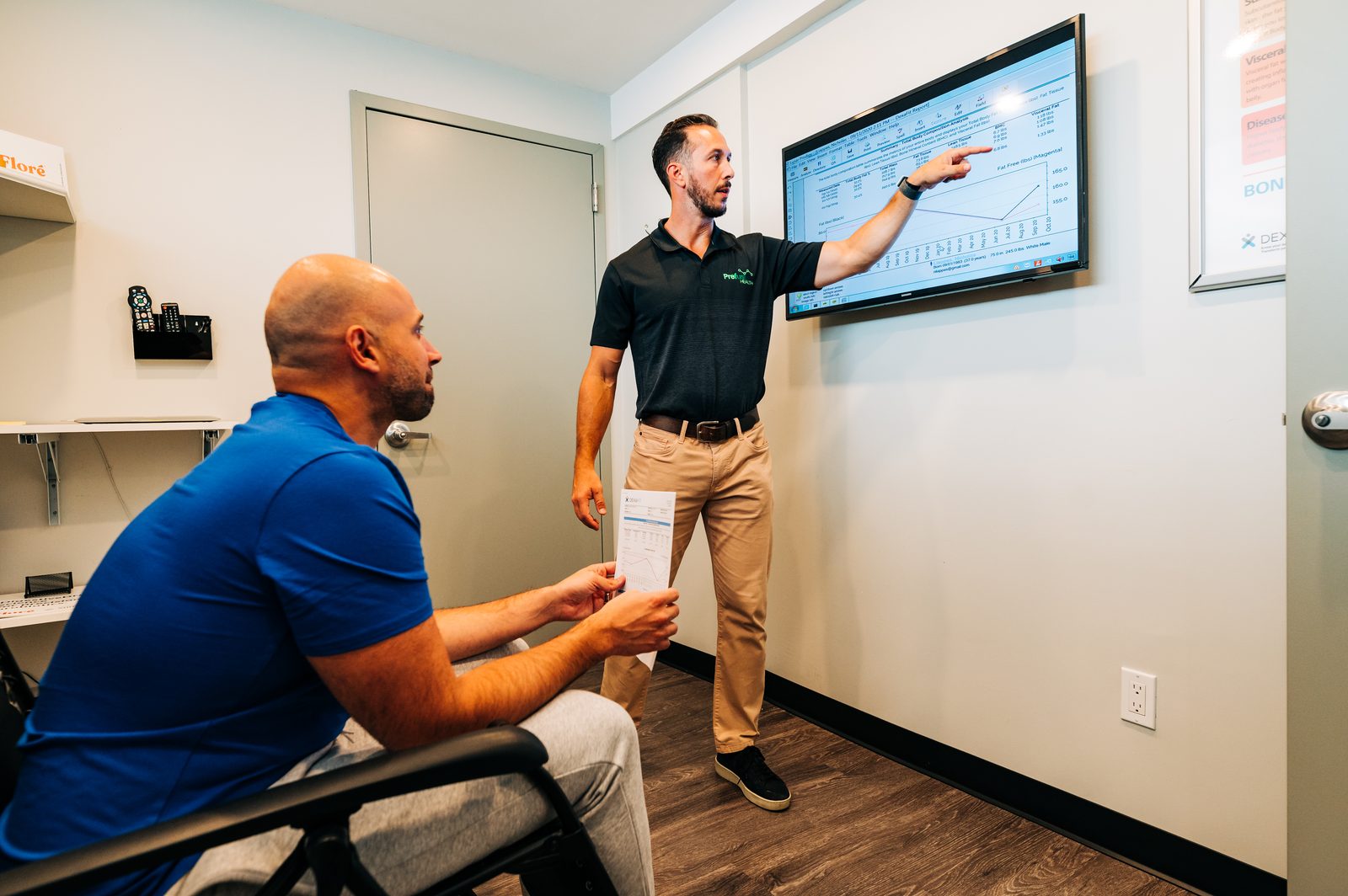
Prefusion Health offers DEXA scans in Manhattan, Bellmore and Stony Brook. A single scan is $179 and includes an in-person walkthrough of your results with a team member, so you understand your report and know what to change next. See all three addresses on the locations page.
Body recomposition is not about losing pounds. It is about losing fat while keeping or building muscle. Consistent training, enough protein and good recovery drive it. Tracking a few measures together, with a DEXA scan as your baseline, shows you whether it is working.
$179 per scan, about seven minutes, in Manhattan, Bellmore or Stony Brook.
About seven minutes on the scanner, fully clothed, with no needles or discomfort.
Yes. It is one of the few accessible tests that can measure the fat stored around your internal organs.
About every 90 days if you are working toward a fitness or weight-loss goal.
Prefusion Health offers DEXA scans in Bellmore and Stony Brook on Long Island, and in Manhattan.
This article is for general education and is not medical advice. Whether a test or therapy is right for you is decided with your provider, based on your health history and results.
What a $179 DEXA scan includes, how to prepare, and where to book in Manhattan, Bellmore and Stony Brook.

Body fat, lean mass, visceral fat and bone: what each number on your DEXA report means and how to use it.
Book your baseline and let the data do the talking.